
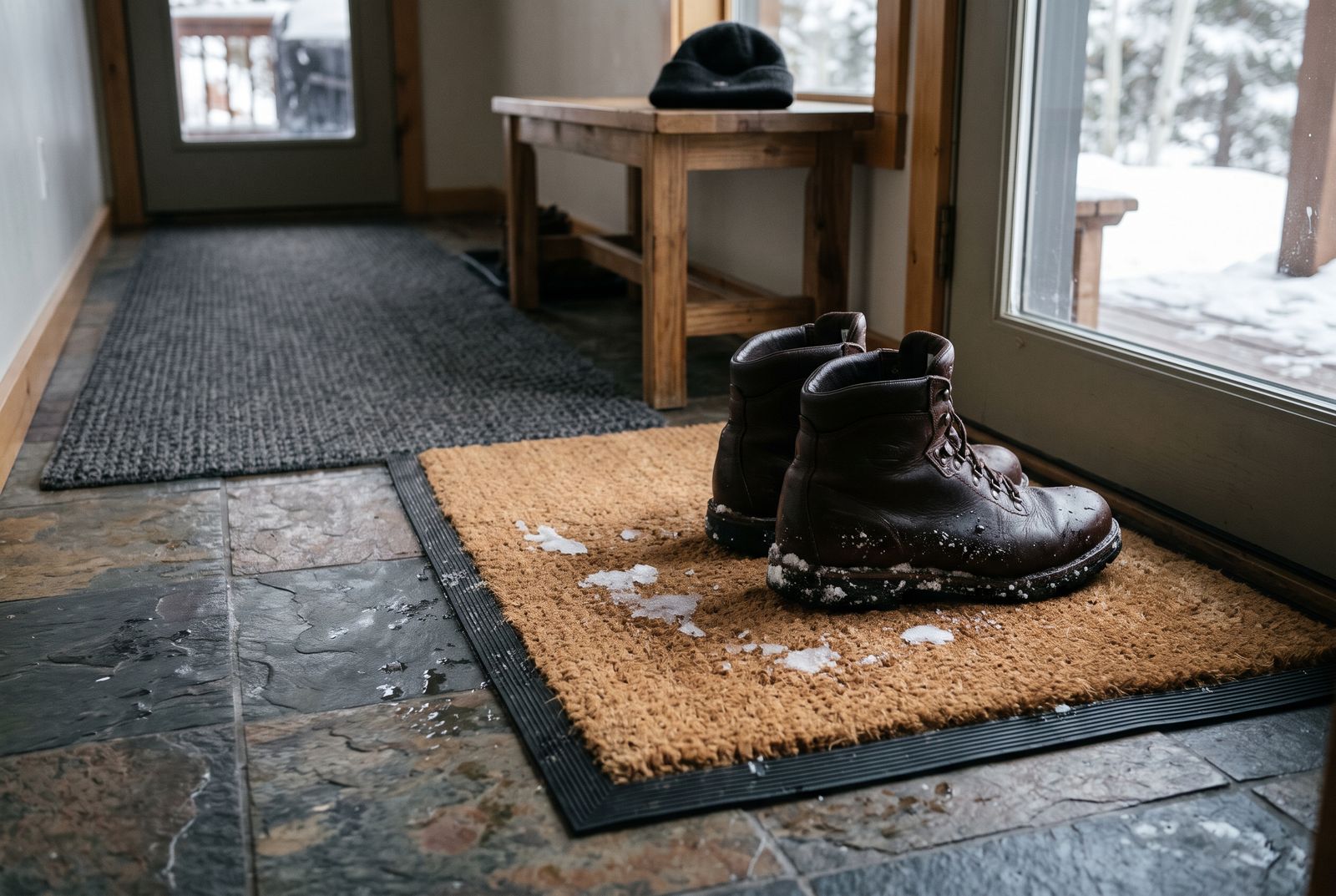
What actually rides in on your boots
Snow is the part you can see. The damage comes from what is dissolved and mixed into it.
Colorado roads and sidewalks are treated through the winter with a mix of sand, gravel and chemical deicers, magnesium chloride chief among them. Mag chloride works well on ice. It is also hygroscopic, meaning it pulls moisture out of the air, which is why the film it leaves on floors can stay tacky and keep grabbing dirt long after the boots are gone.
| Material | What it does | First response |
|---|---|---|
| Snowmelt | Wets the pile and carries everything else deeper | Blot with a dry towel; let it air dry |
| Sand and gravel | Grinds at the base of the fibers, dulling and thinning them | Vacuum slowly and often near doors |
| Mag chloride and salt | Leaves a white, sometimes tacky film that attracts soil | Dissolve with warm water, then rinse and blot |
| Mud | Stains if rubbed in while wet | Let it dry fully, then break up and vacuum |
Build a walk-off zone at every door you use
Commercial buildings plan matting carefully because most of the soil that reaches the interior gets carried in on the first steps through the door. A house can use the same idea at a smaller scale.
- Outside: a coarse scraper mat (rubber, coir or bristle) knocks off snow and gravel.
- Inside the door: a hard surface such as tile or sealed concrete, where boots come off and puddles can be wiped up.
- Then: an absorbent fabric mat with a rubber backing, long enough for a few steps, to catch moisture and fine grit.
- Only after that, carpet.
A mat that is too small is mostly decoration. If people step over it, it is not doing anything. Shake or vacuum mats often during storms; a saturated mat just moves the water further in.
Keep a boot tray and a bench right at the door. People take boots off where it is easy to sit down. In a house with carpet in the front hall, that bench may do more for the floor than any carpet upgrade.
Choosing carpet that sits near an entry
If carpet starts close to a door, choose for grit and moisture first and softness second.
- Nylon in a dense, low-profile cut pile or tight cut-loop resists crushing and cleans well.
- Avoid large-loop berber in these areas. Grit settles between loops, and loops can fuzz with wear.
- Medium, flecked colors hide the faint haze deicer leaves behind. Very light or very dark solids show it.
- A washable runner in the hallway takes the abuse so the carpet underneath does not.
Our buying guide decision matrix covers the rest of the house.
Cleaning mag chloride and salt residue
Deicer residue is mostly a mineral film. Detergent alone does not remove it well and can leave its own sticky residue. Warm water does most of the work.
- Vacuum the dry area first to remove loose grit.
- Test in a hidden spot. Check your carpet maker's cleaning guidance, especially for wool.
- Dampen a clean white cloth with warm water and blot the haze; do not scrub. Many people add a small amount of white vinegar to the water for stubborn film on synthetic carpet.
- Rinse by blotting with plain water, then press dry with towels. Avoid soaking the pad.
- Let it dry, then vacuum to lift the pile.
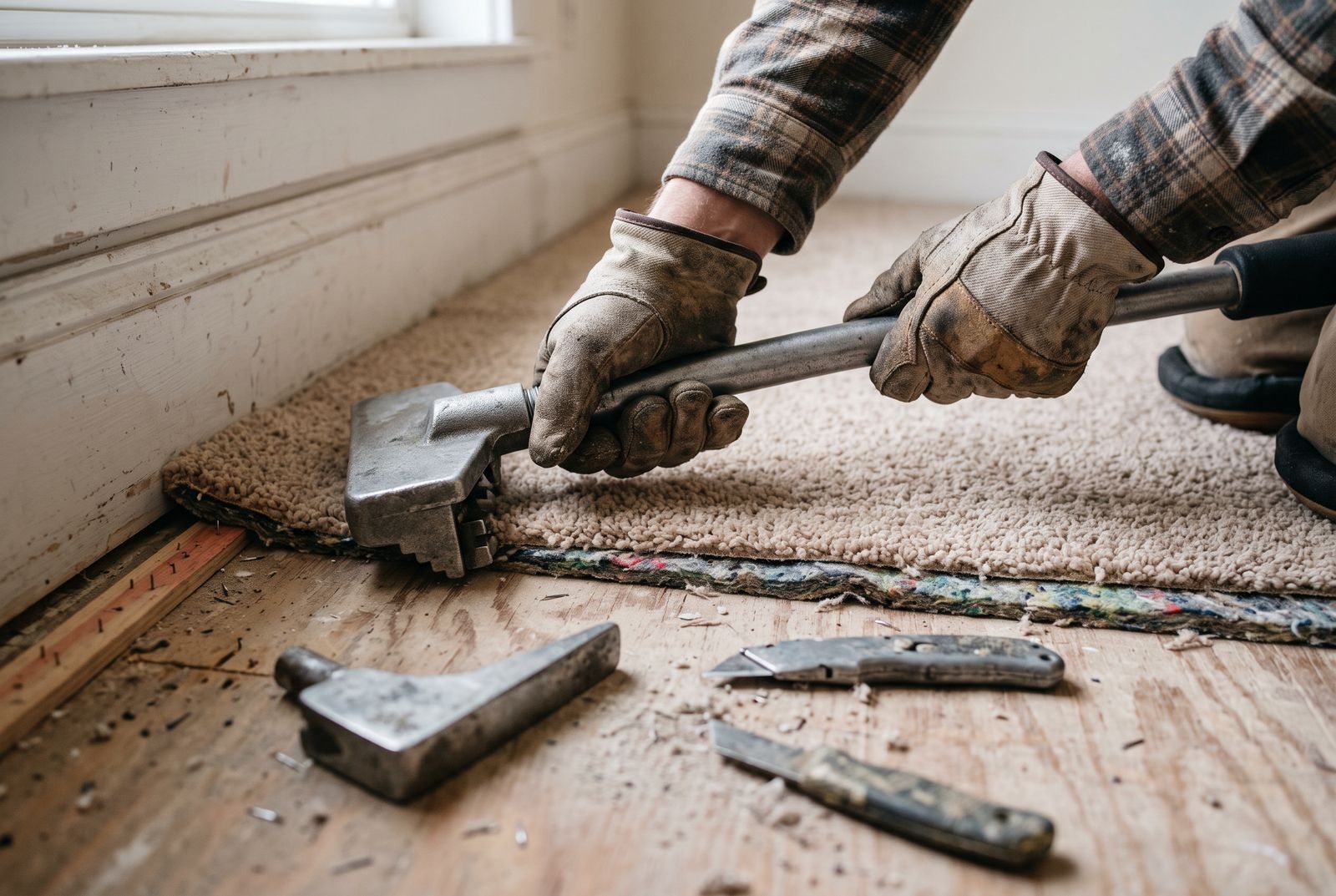
Mud season, spring and fall
Colorado's shoulder seasons bring freeze-thaw mud, especially in mountain towns and on new construction lots without landscaping. Treat mud differently from snowmelt.
Let it dry completely. Break up the dried clumps with a dull edge or a stiff brush, then vacuum slowly from several directions. Only then treat any remaining stain with a carpet-safe spotter. Wet mud rubbed with a towel spreads into a wider, deeper stain that is much harder to remove.
Dogs, paws and deicer
Dogs bring in the same grit and chemical residue on their paws, and deicer can irritate their pads too. A towel and a shallow tray of lukewarm water by the door handles both. Ask your veterinarian about paw care in winter if your dog seems sore after walks. For carpet in homes with pets, triexta and nylon in a cut pile are the usual recommendations; the fiber matchmaker factors that in.
Quick answers
What is the white film on the carpet by my front door?
In most Colorado winters it is residue from road and sidewalk deicers such as magnesium chloride, carried in on shoes. It dries to a whitish haze and can feel slightly tacky.
Should I vacuum mud while it is wet?
No. Let mud dry completely, break it up gently, then vacuum. Rubbing wet mud pushes it deeper into the pile and spreads it.
Is a rug on top of carpet a good idea at the entry?
It can be, as long as the rug has a backing that will not stain or trap moisture against the carpet. A washable runner over carpet in a hallway is far easier to clean than the carpet beneath it.
The bottom line
- Stop grit and deicer with a real walk-off zone before it reaches carpet.
- Use warm water and blotting on deicer haze, not heavy detergent.
- Let mud dry before you touch it.
- Choose dense nylon or triexta in a mid-tone near any door.
Entry carpet beyond saving?
Describe the area, how people come and go, and what flooring sits next to it.