
Why Colorado houses zap you all winter
Static is charge that builds up and has nowhere to go. Humid air bleeds it off. Dry air lets it pile up until your fingertip finds a doorknob.
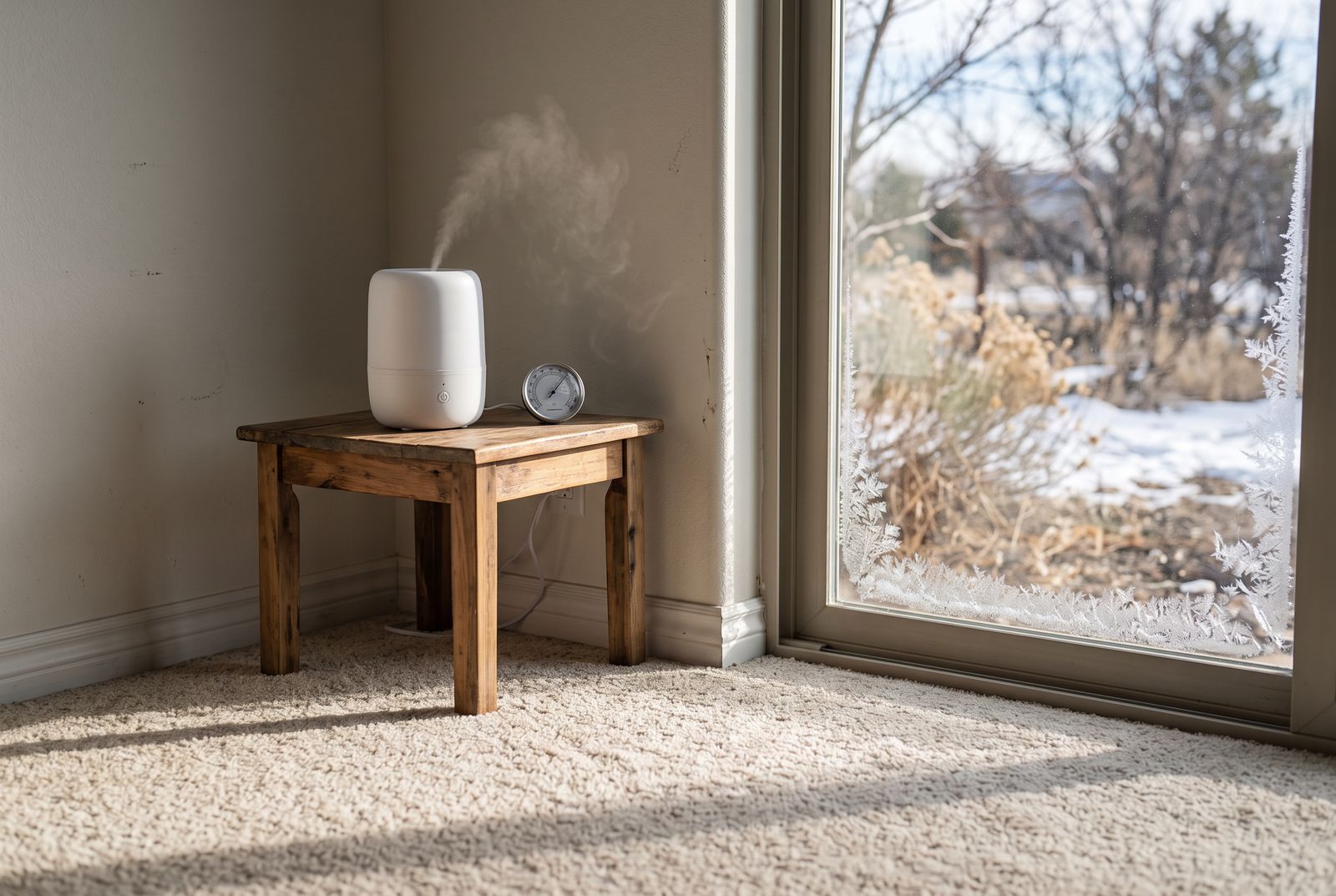
Colorado's climate is semi-arid to begin with. In winter, cold outdoor air holds very little moisture, and when the furnace warms that air inside, its relative humidity drops further. The result is indoor air that can sit well under 30 percent for weeks at a time in a house with no humidifier.
Walking across carpet transfers electrons between your shoes and the fibers. That happens in Florida too. The difference is that a humid house drains the charge away almost as fast as you build it, while a dry Colorado house lets it accumulate with every step. Rubber-soled slippers and socks on certain fibers make it worse; bare feet and leather soles make it better.
Many people do not feel a static discharge until the body is carrying something in the range of a few thousand volts. Carpet static testing (AATCC Test Method 134) measures the voltage a person builds while walking on a sample under controlled low humidity, which is why "static control" claims usually cite a number in kilovolts.
Static risk dial
Slide to your indoor humidity (a cheap hygrometer will tell you) and pick a carpet type. The dial is a rule of thumb built from general guidance, not a lab measurement, but it shows how much more the humidity matters than the fiber.
Indoor humidity: 20%
The humidity target: high enough for comfort, low enough for the windows
The U.S. Environmental Protection Agency suggests keeping indoor relative humidity between 30 and 50 percent. In a Colorado winter the realistic target is the low end of that range. Push much past it on a very cold night and you will see condensation on window glass, which can lead to stained sills and mold.
| Type | Good at | Watch for |
|---|---|---|
| Whole-house (on the furnace) | Steady humidity everywhere, no tanks to fill | Needs installation and annual pad or filter service |
| Evaporative room unit | Self-limiting output, no white dust | Wicks need regular replacement |
| Ultrasonic room unit | Quiet, visible mist, inexpensive | Hard tap water can leave fine white mineral dust on furniture and dark carpet; distilled water avoids it |
Clean any humidifier on the schedule its maker gives. Standing water in a neglected tank grows things you do not want misted into the bedroom.
What the carpet itself can do
Fiber does play a part. Different materials sit at different points on the triboelectric scale, which is why some combinations of shoe and carpet build more charge than others. In practice, the bigger lever on the product side is whether the carpet includes a static-control feature, usually a small percentage of conductive filament blended into the yarn, which helps the charge dissipate.
That feature is common in commercial carpet and less consistent in residential lines. If static is a real problem in your house, ask for the product's static rating on the spec sheet and compare. Do not rely on a sales description alone.
Shoes, socks and the part you control every day
The charge you carry depends on two surfaces rubbing together: your soles and the carpet. Swap either one and the result changes. Rubber and many synthetic slipper soles pick up a lot of charge on common carpet fibers. Cotton socks tend to do better than fleece or synthetic ones. Leather soles and bare feet sit somewhere in the middle and often feel like a cure on a dry January evening. None of this is precise, because fiber blends, dyes and finishes all shift the numbers, but it explains why one person in the house gets zapped all winter and another barely notices.
Furniture plays a part too. A rolling office chair on carpet builds charge with every push, and that charge ends up in your hand when you reach for the computer. A static-dissipative chair mat, or a hard floor zone under the desk, solves it more reliably than any spray.
Static fixes that work, and one that backfires
- Raise humidity first. Everything else is a patch.
- Change footwear. Leather soles or bare feet build less charge than rubber slippers on most carpet.
- Discharge on purpose: touch a metal key or coin to the doorknob before your finger does. The spark jumps from the metal and you barely feel it.
- Commercial anti-static carpet sprays can help in a pinch. Test in a closet first.
The old trick of misting carpet with diluted fabric softener does reduce static for a while, but it leaves a residue that attracts soil and can interfere with the carpet's stain protection. Many cleaning professionals see it as a cause of fast resoiling.
If this, then that
- the hygrometer reads under 25 percentadd humidity before you blame or replace the carpet.
- windows fog or frost on the insideyou are over target for the outdoor temperature; turn it down.
- you are buying new carpet and static bothers youask for a static rating and a built-in static-control feature.
- a home office has computers on carpetconsider a static-dissipative chair mat, and keep humidity steady.
The bottom line
- Humidity, not fiber, is the main cause of winter shocks in Colorado.
- Aim for the low 30s in winter and watch your windows.
- For new carpet, ask for a static rating in writing. Compare fibers in our buying guide.
Replacing carpet and tired of the shocks?
Tell us the rooms and how dry the house runs in winter, and we will reply by email.