

How rooms are measured, and why your math will not match
Homeowners measure floor area. Installers measure how carpet comes off a roll. Those are different numbers, and the gap surprises people.
Broadloom carpet is made in fixed widths, most often 12 feet, with some lines in 13 feet 6 inches or 15 feet. A room that is 13 feet wide cannot be covered by a single 12-foot piece, so the installer either adds a strip (and a seam) or orders from a wider roll if the product comes in one. Pile direction has to run the same way across every piece in view, so leftover offcuts can only be used in certain spots. Patterned carpet adds more, because each piece has to line up with the next.
That is why a 10-by-13 bedroom (130 square feet, about 14.4 square yards of floor) can call for noticeably more than 14.4 yards of carpet. It is also why two companies measuring the same house can arrive at different totals: they planned the seams differently.
Square-yard estimator
Use this to sanity-check a quote, not to order carpet. It shows three numbers: the bare floor area, area plus an allowance, and a rough roll-cut estimate that covers each room in full-width strips the way a single roll would be cut.
Estimate carpet for your rooms
Stairs, closets, pattern repeats and hallway layouts change the real number. Only an on-site measure produces a buying quantity.
Where seams belong (and where they do not)
Every carpet with more than one piece has seams. A good seam is hard to find; a bad one shows up as a line, a peak or a gap. Placement decides most of that.
- Seams should run in the same direction as the main light source where possible, so raking light from a window does not cut across them.
- Keep seams out of doorways and the main walking path. A seam under a sofa is better than one in front of it.
- The cut edges should be sealed with seam adhesive before they are joined, which keeps tufts from working loose over time. Industry installation standards call for it.
Ask for a seam diagram with the quote. If the plan puts a seam across the middle of a living room to save a few yards, you can ask whether a wider roll or a different layout is an option.
Stretching: the step that prevents ripples
Carpet is held in place at the walls by tack strip, a thin wooden strip with angled pins. To stay flat for years it has to be stretched tight across the room before it hooks onto those pins.
| Tool | What it does | Where it belongs |
|---|---|---|
| Power stretcher | Braces against the opposite wall and uses a long, telescoping pole to pull the carpet tight across the whole room | Most rooms, per common installation standards |
| Knee kicker | A short tool bumped with the knee to nudge carpet onto the strip near walls | Closets, tight spots, and positioning edges |
A carpet that was only knee-kicked can look fine on day one and develop waves within a season or two. Heat swings, heavy furniture rolling across it, and a pad that is too soft all make it worse. Ask directly whether a power stretcher will be used in every room large enough for one.
Install day, step by step
- Clear the room. Remove breakables, electronics and anything on the floor of closets. Confirm in advance who moves furniture.
- Tear-out. Old carpet and pad come up, staples are pulled, and damaged tack strip is replaced.
- Pad goes down. Seams in the pad are taped and should not line up with the carpet seams above.
- Carpet is rough-cut and seamed. Pieces are laid out with matching pile direction, edges sealed, and joined.
- Stretch and trim. The carpet is power-stretched onto the tack strip and trimmed tight to the wall.
- Transitions and doors. Edges at tile or wood get transition strips. Doors may need trimming if the new carpet is thicker.
- Walk-through. Look at seams in daylight, check closets, and make sure registers and vents are back in place.
In winter, keep the heat on in the house before and during install. Many manufacturers specify a temperature range for the carpet and room during installation. Afterward, open windows or run ventilation for a couple of days; the Carpet and Rug Institute suggests 48 to 72 hours of fresh air after new carpet goes in.
Stairs and transitions
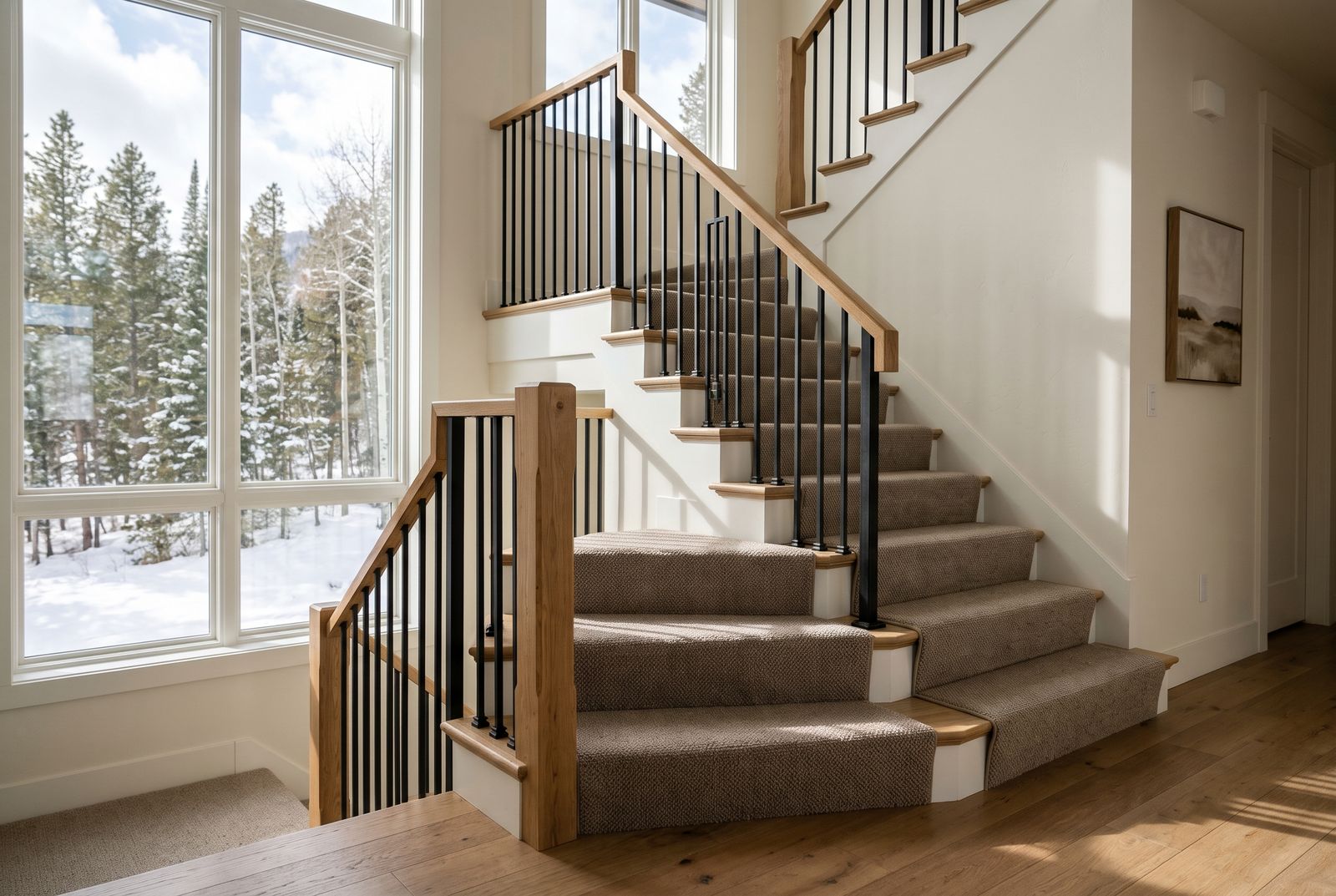
Stairs are their own craft. A waterfall install lets the carpet drape over the stair nose and drop straight down the riser; it is faster and usually less expensive. A cap-and-band or upholstered install wraps the carpet tightly around the nose and tucks it under, which looks tailored and costs more time. Runners leave wood exposed at the sides and need a decision on binding and how the runner is anchored.
Where carpet meets tile, wood or vinyl, the transition piece has to suit both heights. Ask what will be used at each doorway, especially at kitchen and bathroom thresholds and at the top of basement stairs.
Reading the quote line by line
A clear quote lists each of these separately. If one is missing, ask whether it is included or extra.
| Line item | What to confirm |
|---|---|
| Carpet | Product name, color, square yards, roll width |
| Pad | Thickness, density, and that it meets the carpet maker's spec |
| Labor | Rooms covered, power stretching, seam sealing |
| Tear-out and haul-away | Old carpet, pad, and whether disposal is included |
| Stairs | Number of steps, install style, landings |
| Transitions and doors | Strips at each doorway, door trimming |
| Furniture | What the crew moves and what they will not |
| Workmanship warranty | Length and what it covers, in writing |
The bottom line
- Expect to buy more carpet than your floor area; seams and roll widths explain the difference.
- Ask for a seam diagram and a commitment to power stretching.
- Use tear-out day to fix squeaks and stains in the subfloor.
- Then keep it looking new with our carpet care guide.
Want an installation quote?
List the rooms and stairs, and note anything special about the subfloor or access.